Niagara College and global partner connect worlds through Game Development
This article was published on: November 12th, 2025
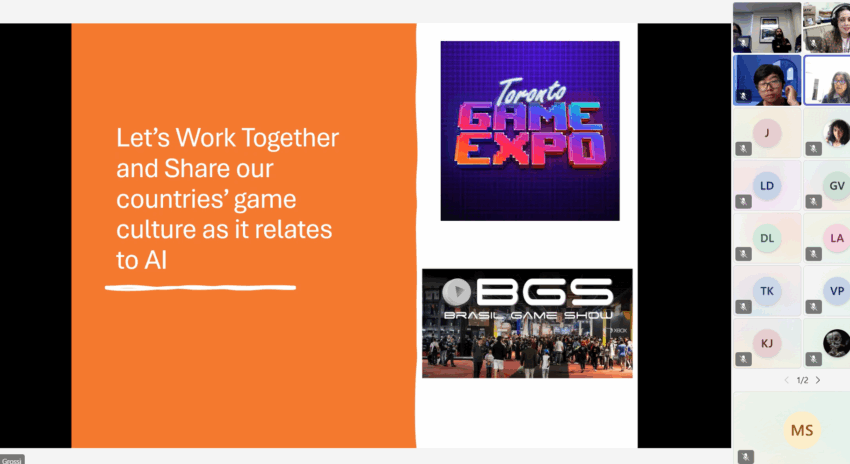
In an inspiring testament to international collaboration, Niagara College worked with academic partner Senac, from Brazil, to create a unique global learning opportunity for students from both institutions this fall.
The initiative was a micro-Collaborative Online International Learning (COIL) experience, designed to connect learners through their shared passion for Game Development. Focused on Creative Uses of Artificial Intelligence (AI) in Game Development, the project engaged more than 25 students across two virtual sessions coordinated by NC’s Office of Cultural and Global Engagement in partnership with the School of Media.
“NC is committed to developing innovative ways to support global learning inside and outside of the classroom, and this was an amazing example of intercultural and vocational exchange,” said Maxine Semple, Director of Cultural and Global Engagement. “The experience created an easy and engaging environment where learners from both institutions could come together and share lessons about their vocation.”
Beatriz Blanco, Senac’s Coordinator of Multimedia Production Technology and Digital Game Development Technology, noted that partnering with NC was a joy, thanks to the strong sense of connection and teamwork between the teams.
“From the very first conversations, we identified many alignments between our approaches in the classroom, so the project naturally evolved in a very collaborative way,” said Blanco. “My biggest takeaway was that, despite the geographic distance, game development educators share much in common in our teaching methods and goals. I look forward to future opportunities and projects together.”
Gina Grossi, Professor at NC’s School of Media, shared that collaborating with NC International and Senac offered valuable opportunities for creative exchange and teamwork.
“Developing the project with Senac was exciting, due to both the open-mindedness of the teams about potential topics and the mutual appreciation of everyone regarding the opportunity for collaboration,” said Grossi. “Also, having never participated in a global educational collaboration before, I was surprised at how smoothly the process progressed from the planning stages to project delivery. The support we received from the Office of Cultural & Global Engagement was instrumental in this successful collaboration.”
Learning across borders
During the first session, held on October 2, faculty from both institutions introduced key concepts in game development and AI, sharing examples from their respective countries. Students were then grouped by institution and challenged to research a video game developed in their home country. On October 16, the groups reunited virtually to present their findings, exchange ideas, and discuss cultural influences on game design.
A post-project survey showed that 100% of students learned something new from a peer abroad. The same number also said they enjoyed the experience and found it valuable — giving it an enthusiastic thumbs up.
“My perspective of the game development industry has mostly been locally centred, but this experience made me think about the industry on a wider scale,” said NC Game Development program student Aaralyn Pennings. “Hearing about the different uses of artificial intelligence and how it can be intertwined with cultural relevance enhanced my understanding of game development in other countries, as well as opening my world view as a person.”
Kayanna Saylor, another NC Game Development student, noted that collaborating with international peers reminded her to consider a global audience and the broader impact of games.
“The experience with Brazilian students reminds me to not only think of the western audience but the whole world and how games can build empathy and compassion through a more personal lens,” said Saylor. “As a game developer, I think it is important to remember my responsibility and the importance of the contributions I make to the media.”
For Gabriel Wesley Santos, a Digital Games Technology student from Senac, the sessions offered fresh insights into using AI in games and highlighted how each country brings its own creative style.
“The sessions opened my mind to new ways of working with AI in games,” said Santos. “It was inspiring to see how the games chosen by students from each country reflected their unique cultures, ideas, and ways of storytelling.”
Intercultural teaching
From the perspective of Senac and Niagara College, both educators emphasized the intercultural value of the project.
“For our students, the activity highlighted both the similarities and unique perspectives of game developers from the two countries, emphasizing their role in an international professional community while practicing communication and cross-cultural skills,” said Blanco.
“Collaboration with people from different cultures allows for a diversity of perspective, enabling us to examine a topic through a different lens, enhancing our ability to learn while expanding our understanding of a topic as a result,” added Grossi.
The success of this initiative reflects NC’s commitment to enabling students to experience culturally diverse learning environments, gain global perspectives, and develop practical skills, preparing world-ready and work-ready graduates.
If you are a faculty member interested in working on establishing a global micro-COIL learning opportunity for your students in your classroom here in Niagara, reach out to Maxine Semple, Director of Cultural and Global Engagement, at [email protected].